
ADHD Money Management: Why Budgeting Fails Your Brain and What Works Instead

Traditional budgets often depend on memory, time awareness and constant self-control. ADHD-friendly money management uses automation, visual cues and simple systems that keep working when motivation disappears.
Money management can become a shame loop when you have ADHD.
You avoid checking your account because the number feels scary. You spend impulsively because you need relief, stimulation or a quick reward. You create a detailed budget when motivation is high, miss one category a few weeks later and decide the whole system has failed.
Then the cycle starts again.
This is not a character flaw. It is a system problem.
Traditional budgeting asks you to track every purchase, remember every due date, estimate how long money will last and make consistent decisions about the future. Those are the same executive function skills ADHD can make harder.
Better ADHD money management does not depend on becoming a different person. It builds enough structure outside your brain that your money can keep moving in the right direction, even on an overwhelmed day.
Why traditional ADHD budgeting fails
A standard budget is not automatically bad. The problem is that many budgets are designed for a brain that can reliably plan, remember, categorize and delay rewards.
ADHD and money can become especially difficult when a system requires all of those skills at once.
Money avoidance turns information into a threat
If you have dealt with overdrafts, late fees, debt or years of feeling behind, opening your banking app may trigger anxiety before you even see the balance.
Avoidance can look like:
- Leaving bills unopened
- Ignoring account notifications
- Forgetting to cancel subscriptions
- Waiting until a problem becomes urgent
- Refusing to look because you already know it will be “bad”
The problem is that avoidance creates more uncertainty. Uncertainty creates more anxiety. More anxiety makes the next money task even harder to start.
A shame-based approach tells you to be more responsible. A practical approach makes looking at your numbers feel safer and smaller.
Your first goal is not to fix everything. It is to make contact with reality without spiraling.
Emotional dysregulation makes spending feel urgent
ADHD spending is not always about wanting something. Sometimes it is about wanting to feel different.
A purchase can offer novelty, comfort, relief from boredom or a temporary break from stress. When emotions are intense, the future cost may feel distant compared with the immediate reward.
That is why a budget based on “just use more self-control” tends to fail. It treats emotional spending as a moral issue instead of a predictable pattern that needs guardrails.
A better system includes some guilt-free spending money, so every purchase does not feel like a forbidden choice. It also adds friction where impulsive spending is most likely to happen.
Time blindness hides future bills
A bill due in three weeks can feel imaginary when you are focused on today. Then the due date suddenly arrives and the money is not available.
Time blindness can affect:
- Remembering when bills are due
- Estimating how long a paycheck must last
- Preparing for annual expenses
- Noticing that a subscription renewed
- Starting a task before it becomes urgent
A calendar reminder helps, but reminders alone are not enough if the money is still mixed together in one account. The system must make future obligations visible and protect the money before it is spent.
All-or-nothing thinking turns one mistake into total failure
Many people approach budgeting with rules that are too rigid.
They track every category perfectly for two weeks, overspend once and decide they are terrible with money. Or they make a plan that leaves no room for an unexpected expense, a low-energy week or a small treat.
This is all-or-nothing thinking. It turns a useful system into a test you can fail.
ADHD-friendly budgeting needs recovery built into it. The question is not, “Did I follow the plan perfectly?” The better question is, “What would make it easier to return to the plan?”
What works better for ADHD money management
The most useful systems are simple, visible and forgiving. They reduce the number of decisions you must make in the moment.
Automate the bills you can
Automation is not about giving up control. It is about removing repetitive tasks from a brain that should not have to remember them every month.
Start with stable expenses such as:
- Rent or mortgage
- Insurance
- Phone service
- Internet
- Minimum debt payments
- Regular subscriptions you intend to keep
Set autopay only when you have enough account protection to avoid overdrafts. Turn on balance alerts and payment notifications so automation does not become invisible.
If possible, schedule payments shortly after your paycheck arrives. This matches the timing of your income instead of relying on memory later in the month.
Separate money by purpose
One account with one balance often creates confusion. You may see money available and assume it is safe to spend, even though part of it is needed for bills.
External scaffolding can help. Consider using separate accounts or labeled bank buckets for:
- Bills
- Everyday spending
- Savings
- Irregular expenses
The bills account should have one job. If possible, do not attach a debit card to it. Your everyday spending account should show what is actually available for food, fun and flexible purchases.
This is not about creating more financial complexity. It is about making the right choice easier to see.

Use a low-effort spending system
You do not need to categorize every coffee, snack or online purchase to make progress.
Try a three-bucket system:
- Essentials
- Flexible spending
- Savings or debt
The percentages do not have to follow a perfect 50/30/20 split. Your housing costs, income, debt and family responsibilities may require different numbers.
The important part is limiting the number of categories. Broad buckets are easier to maintain than a detailed spreadsheet with 25 spending labels.
If your flexible spending account is empty, that is useful information. It tells you to pause until the next transfer. You do not have to investigate whether the money went to restaurants, clothing, entertainment or small household purchases.
Track one number
Detailed tracking can create more anxiety than awareness. For many people, a single number is more useful.
Choose one number to check during your weekly money appointment:
- The amount available until your next paycheck
- The balance in your everyday spending account
- The amount needed to cover bills before payday
- Your current savings buffer
Write it in one place, such as a phone note, whiteboard or paper planner. Use the same format each time.
Your check-in can be as simple as:
- What is my one number?
- What bills are due before my next paycheck?
- What is one action I can take?
That is enough for a starting system.

Add friction to impulse spending
You do not need to eliminate every impulse. You need to slow down the purchases that create problems.
Try:
- Removing saved card details from shopping sites
- Unsubscribing from promotional emails
- Moving shopping apps off your home screen
- Using a 24-hour waiting rule for purchases above a chosen amount
- Creating a small impulse fund inside your flexible spending category
- Adding desired items to a wish list instead of buying immediately
The goal is not punishment. The goal is to create enough time for your future self to participate in the decision.
A simple reset you can try this week
Do not start by building a perfect budget. Start with a 20-minute money reset.
First, regulate before you look. Make tea, take a short walk or put on calming music. The goal is to make the task feel uncomfortable but safe.
Next, open one account. Do not review every credit card, loan and retirement account at once.
Then write down:
- Your current available balance
- Bills due in the next 14 days
- One financial action you can complete today
That action might be turning on an alert, moving a small amount to savings, canceling one subscription or scheduling one payment.
Stop after that if you need to. A short check-in you repeat is more useful than a six-hour financial overhaul you never want to do again.
For more support, read The ADHD Financial Anxiety Reset, Face Your Numbers with Calm. You may also find How to Start a New Habit When Your Motivation Disappears and 7 Mistakes You’re Making with Your ADHD Success Habits useful when you are building systems that need to survive low motivation.
Coming soon, The ADHD Financial Anxiety Reset
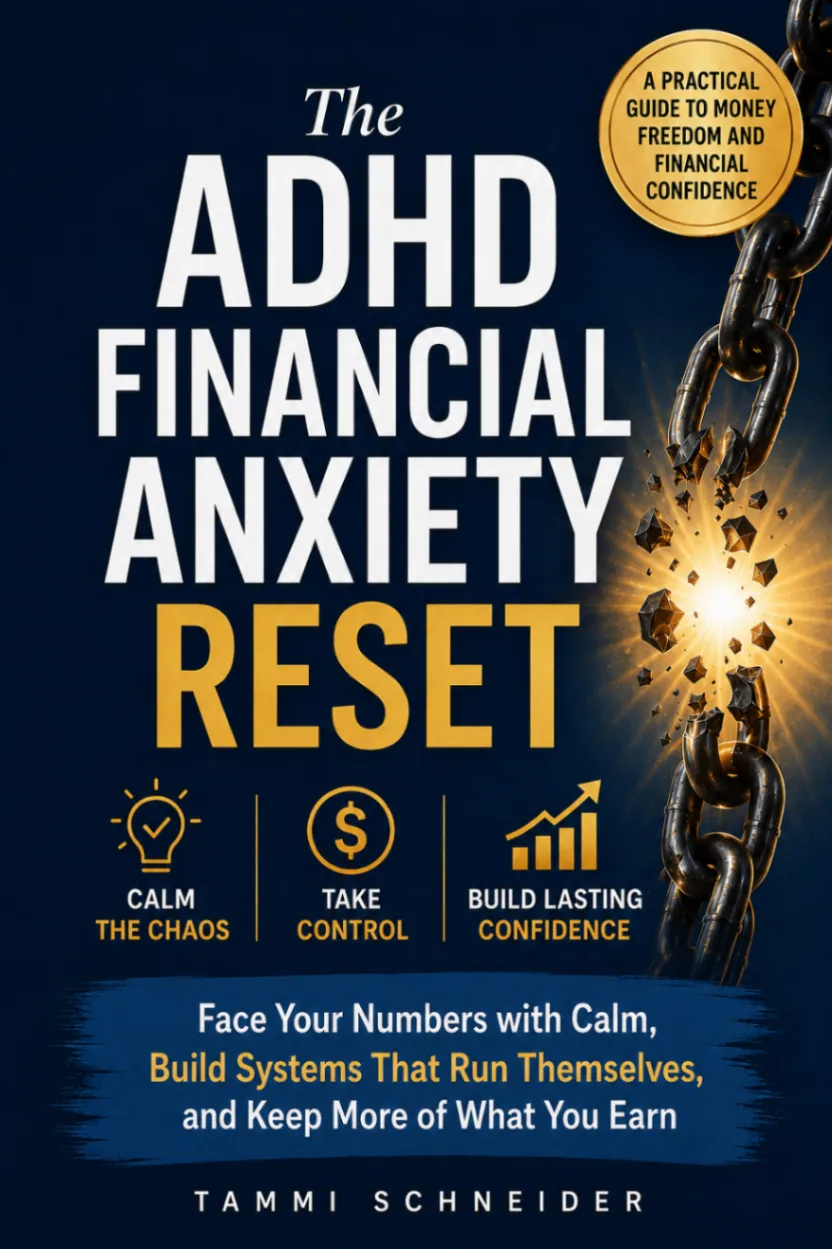
These ideas are part of the approach behind Tammi Schneider’s upcoming book, “The ADHD Financial Anxiety Reset, Face Your Numbers with Calm, Build Systems That Run Themselves, and Keep More of What You Earn.”
The book is designed for adults with ADHD who want practical help with avoidance, emotional spending, time blindness and financial overwhelm. It focuses on systems that reduce daily effort instead of demanding more discipline.
“The ADHD Financial Anxiety Reset” is coming soon on Amazon.
If you are working on the broader relationship between ADHD, routines and overwhelm, you can also read The 5-Minute Morning Routine That Actually Works for ADHD Women and 7 Practical Ways to Manage Anxiety Without Overhauling Your Life.
A practical book for ADHD women with big dreams

Money systems are only one part of creating a life that works with your brain.
“ADHD Women with Big Dreams, Simple Routines for More Focus and Confidence to Handle Overwhelm so You Always Remember Why You Walked Into the Room” offers realistic support for focus, routines, distraction and starting over without shame.
The message is simple, your brain is not the problem. You need tools that fit the way your brain works.
ADHD Women with Big Dreams is available on Amazon.
You do not need a perfect budget. You need a system that still works after a hard week.
Start with one account, one number and one next step. Then build from there.